🌿
Portmeirion Botanic Garden · Est. 1972 · Stoke-on-Trent, England
The Flower Guide
Every motif in our current inventory, with English name, Latin name, and hero image. Botanic Garden was the pattern that proved mix-and-match could be a philosophy, not a compromise.
🍎
Portmeirion · Other Ranges
Beyond Botanic Garden
Portmeirion produced several other significant ranges alongside Botanic Garden. We carry pieces from Pomona and Welsh Dresser.
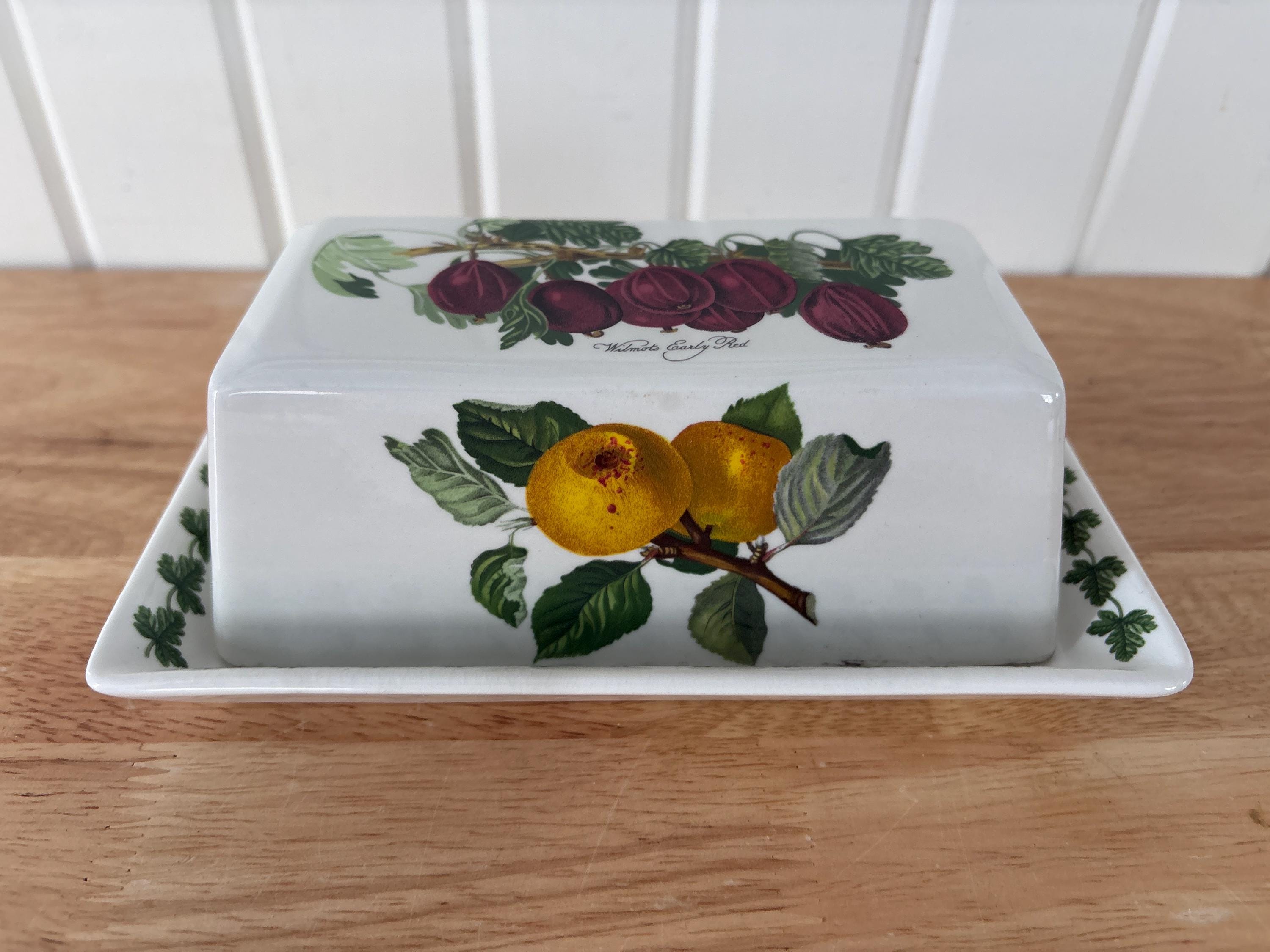
Pomona
Launched alongside Botanic Garden, Pomona takes the same botanical illustration approach and applies it to fruit — apples, pears, plums, currants, and more, each named by variety (Royal George, Hoary Apple, Reine Plum). Designed by Susan Williams-Ellis and drawn from the same 19th-century source material as Botanic Garden. The mix-and-match principle applies: every piece carries a different fruit, unified by a consistent border.
Pomona has a devoted following among collectors who find the fruit motifs warmer and more domestic than the florals. It's also somewhat easier to find in complete sets, as it was produced consistently through the 1970s and 1980s.
Browse Pomona Listings →
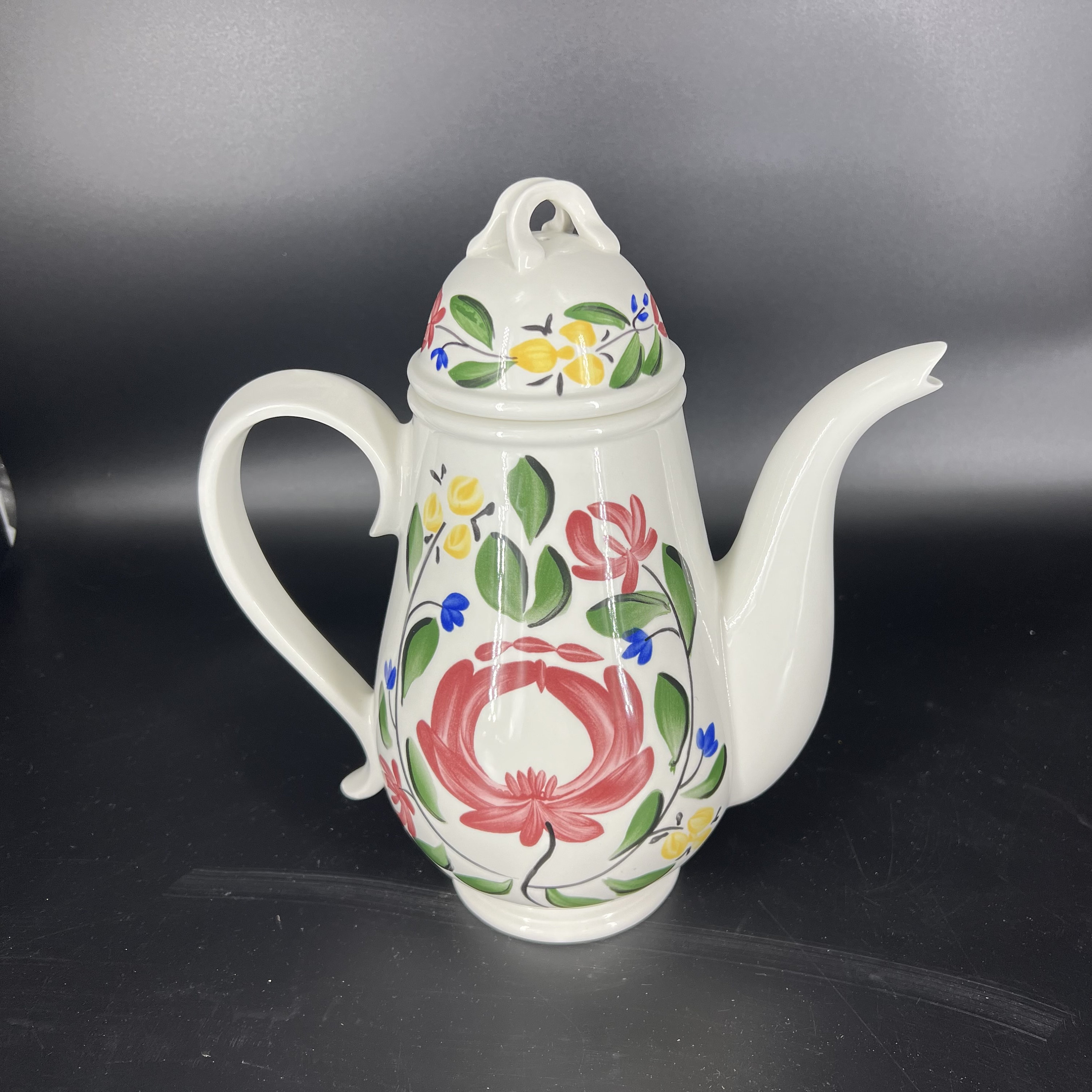
Welsh Dresser
A more decorative range than Botanic Garden or Pomona — the Welsh Dresser pattern features a rich arrangement of mixed flowers and botanicals in a denser, more ornate composition. It references the tradition of the Welsh dresser as a display piece, where mismatched china accumulated over time into something coherent.
Less commonly found than Botanic Garden, and with a smaller original production range. Coffee pots and creamers are the pieces most likely to surface. The pattern rewards closer inspection — there's more visual complexity per piece than in the cleaner Botanic Garden designs.
Browse Welsh Dresser Listings →
📖
Stoke-on-Trent · Wales · 1960–present
From a Gift Shop to a Global Pattern
The story of Portmeirion begins not in a factory but in a tourist village on the Welsh coast — and the woman her father asked to stock his shop.
Portmeirion Botanic Garden didn't emerge from a design brief. It emerged from a woman who loved flowers, a pile of 19th-century botanical books, and a set of buyers who told her it would never sell.
1950s
A Shop in a Village
Susan Williams-Ellis — daughter of Welsh architect Sir Clough Williams-Ellis, who built the Italianate village of Portmeirion in North Wales — began selling pottery in the village gift shop. Some pieces were designed by Susan herself, manufactured by A.E. Gray & Company in Stoke-on-Trent.
1960 – 1962
Portmeirion Potteries Founded
Susan and her husband Euan Cooper-Willis acquired A.E. Gray & Company, then Kirkhams Ltd. The two businesses were combined at Kirkhams' premises in Stoke-on-Trent, where Portmeirion has remained ever since. Early designs — Malachite, Moss Agate, Talisman — were critically acclaimed but produced in small quantities.
1963 – 1970
Totem and the Mid-Century Years
The Totem design (1963) — an abstract pattern based on primitive forms, on a distinctive cylindrical shape — established Portmeirion's reputation for bold, contemporary design. Magic City (1966) and Magic Garden (1970) followed. These pieces are collected today as mid-century design objects in their own right.
1972
Botanic Garden Launches
Susan drew from Thomas Green's Universal Herbal (1817) and Rebecca Hey's The Moral of Flowers to create a range where every piece carried a different botanical illustration, unified by a laurel leaf border. Department store buyers said it wouldn't sell — no-one would want a dinner set that didn't match. Susan's view was that a table should be a collection, not a uniform. She was right.
1972 – present
The Mix-and-Match Philosophy
Botanic Garden's commercial success validated an idea that now seems obvious: collectors and buyers want to build a table over time, acquiring individual pieces rather than buying a complete set. The range continues to generate over £30 million in annual sales and remains Portmeirion's highest-selling pattern.
1978
A Welsh Factory
A factory opened near Portmeirion Village for local production. Manufacturing proved impractical there, but seconds from Stoke were hand-painted and decorated for local sale. Pieces from this factory carry a distinctive pink dragon backstamp reading "Porthmeirion Cynnyrch Cymru" — these are a separate collecting category.
1988
Listed on the London Stock Exchange
Portmeirion listed publicly, transferring to the Alternative Investment Market in 2004. Susan Williams-Ellis received an honorary fellowship from the University of Arts London in 2005 and an Honorary Degree from Keele University for her contribution to the ceramics industry.
2007
Susan Williams-Ellis Dies
Susan Caroline Williams-Ellis died on 26 November 2007, aged 89. She had co-founded Portmeirion Pottery with her husband and was best known for the Botanic Garden range — still in production half a century after she designed it. Production has continued under Portmeirion Group, now part of the Enesco family of brands.
The Source Material
The Botanic Garden illustrations are adapted from two main 19th-century sources: Thomas Green's Universal or Botanical, Medical and Agricultural Dictionary (1817) and Rebecca Hey's The Moral of Flowers. The range looks back to a tradition begun by the Chelsea porcelain factory's "botanical" designs of the 1750s — making Botanic Garden part of a 270-year lineage of British botanical ceramics.
That source history is practically useful for collectors: the original illustrations can be found in digitised archives, which helps with identification. When a piece doesn't carry a pattern name, the botanical illustration itself can often be matched to its source engraving.
Why Collectors Care
Botanic Garden pieces span roughly fifty years of production, with meaningful variation in backstamps, glaze quality, border treatment, and clay body. Made in England pieces — particularly those from the 1970s and early 1980s — are generally regarded as the most desirable. Later pieces made in Portugal or under the current brand are still good quality but don't command the same premiums.
The range's breadth is also part of the appeal: with over 100 different flower motifs produced across dozens of forms, no two collections look identical. That's the point.
🔍
Dating Your Pieces
Backstamps & Dating
The mark on the bottom of a Portmeirion piece tells you where it was made, and roughly when. This guide is a work in progress — more detail coming as we document our inventory.
Portmeirion backstamps changed several times between 1962 and the present day. Learning to read them quickly is one of the more useful skills in this collecting area.
📷
Backstamp photography and dating guide coming soon
General Principles
Until this section is fully built out, a few quick orientation points:
"Made in England" vs. "Made in Portugal"
Pieces marked Made in England were produced at the Stoke-on-Trent factory and are generally the most desirable to collectors. Portugal production began later and is still ongoing. All else equal, England-made pieces command a modest premium.
The Pink Dragon Stamp
Pieces bearing a pink dragon backstamp with the words Porthmeirion Cynnyrch Cymru (note the spelling: Porthmeirion, not Portmeirion) were decorated at the short-lived Welsh factory that operated 1978–1982. These are a distinct and less common variant — made from Stoke seconds, hand-decorated in Wales.
Pattern Name on Backstamp
Not all pieces carry the flower's name in the backstamp — earlier pieces often don't. Later pieces are more likely to include the specific motif name, which helps with identification and replacement hunting.
More detail — including photographs of specific backstamp variations and their date ranges — will be added as we photograph inventory. If you have a piece you'd like help dating, send us a message on Etsy.
📦
Toronto, Canada
Collectors Who Became Dealers
20th Century Collector started as a buying habit and turned into something more deliberate.
We're not a shop that happened to start collecting. We're collectors who realized we'd become a shop.
For years we accumulated vintage ceramics — Portmeirion, Denby, Pyrex, Corningware — the way collectors do: one piece at a time, on instinct, from estate sales and thrift stores and the occasional auction. At some point the inventory outpaced the shelves, and we made it deliberate.
We operate out of Toronto under the name CanadianaCollector on Etsy. The ceramics we source are found in Canada — what comes through our doors reflects what's circulating in the North American secondary market. We photograph what we have, describe what we know, and price fairly.
The pattern guides and care guides are a natural extension of that: if you're hunting for a specific motif to complete a set, or you've inherited a piece and don't know what you have, we'd rather give you something useful than just a listing page. These guides grow as our inventory does.
Browse Our Etsy Shop →
Condition & Grading
We assess each piece against its age. Botanic Garden was made to be used — light utensil marks, minor glaze wear, and small stacking marks are expected on pieces that have been in active service and are noted but not treated as damage. Chips, cracks, crazing, and repairs are disclosed and reflected in price.
Pattern Identification
We answer identification questions, even for pieces not purchased from us. If you have a Portmeirion piece you can't identify, send us a photo through Etsy messages. If we know it, we'll tell you.